

For finance
CPQ margin protection, built into the quote
The discount is already agreed by the time you see it. Quotivity puts the floor inside the quote, while the rep is still building it. Approvals catch what’s outside policy before it sends, not after.
Aptarro’s negotiation cycle went from 29 days to 6.


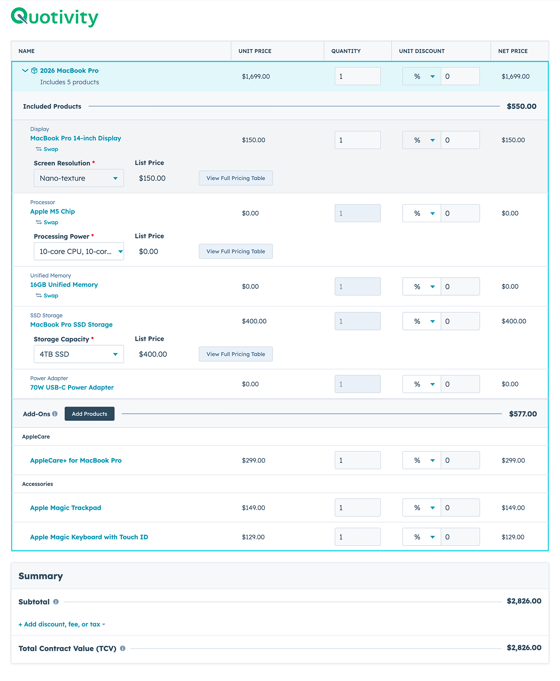
Unit discount and net price on every line. The floor sits inside the quote while the rep builds it, not in a report after it sends.
From 29 (Aptarro)
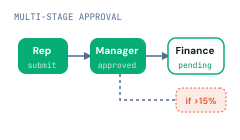
Every exception routes and holds
Professional, no quote required
The short answer
How does CPQ protect margin?
CPQ protects margin by enforcing pricing rules while the quote is built. Prices resolve from the price book assigned to that quote rather than being typed in, discounts past a threshold route for approval before the quote sends, and each product can carry a different formula per price book. None of it depends on a rep remembering the floor.
Only the exceptions route for a signature. Your reviewers see nothing else.
Three places margin leaks in quoting
The discount nobody had to ask for. One portal owner described a quote screen that shows reps the markup formula itself. Some of them quietly trim it, and she does the voice: “this customer of mine, she’s one of my favorites, I’m gonna, you know, tamp down the markup a bit to give her a deal.” Her objection isn’t the deal. It’s that the deal happened somewhere nobody could see it.
The price that got typed instead of looked up. Another operations lead found her reps still pricing from a list two and three years out of date: “We’ve got huge margin leakage. We’ve got people who are putting all sorts of different margins on the core product line depending on how they feel that day.” The current price just wasn’t the easiest one to reach.
The renewal that went out flat. Uplift is the easiest margin in the business to collect and the easiest to forget, because it requires someone to remember to apply it on a quote that otherwise looks like a copy of last year’s.
You might not need this
If your price list is one column and nobody can move a number without asking you first, margin isn’t leaking and this isn’t worth $5,000 a year. What follows is for teams where reps can discount on their own and the policy lives in people’s heads.
Quote controls that hold the margin floor
Four controls that move margin from the report back into the quote. Follow any of them.
Approvals
Advanced Approvals
Route only what’s outside policy. Approvals that hold after you give them.
Formulas
Calculated Pricing
A different formula per price book, per product. Renewal uplift applies itself.
Segments
Price Books
One catalog serves distributor, direct and renewal. No duplicate products.
Transparent
Published Pricing
$5,000 Professional, $10,000 Enterprise. No quote required.
What it’s been worth
| Result | |
|---|---|
| True North — managed IT and cloud provider, healthcare | Around 30% of margin recovered |
| Aptarro | Negotiation cycle 29 days → 6, with fewer errors and fewer clawbacks |
Two customers, not a benchmark. And True North’s number took about a year and a half to arrive in full. You’ll be quoting inside weeks; the margin shows up as deals cycle through, not on go-live.
What it costs
Published pricing, no quote required.
| Professional | Enterprise | |
|---|---|---|
| Annual | $5,000 | $10,000 |
| Included users | 5 | 10 |
| Additional users | $600/yr | $1,000/yr |
| Onboarding (one-time) | $2,500 | $5,000 |
Annual minimum, five seats to start. Full detail on pricing.
What a customer says
From a software company of 51–200 people, on running rules-based quote approvals in Quotivity:
This solves so many different challenges for us internally - specifically rules based quote approvals. It is a great balance of having the core things you need, without being over engineered.
Brian Werbeck — software company, 51–200 employees
What finance asks about quote approvals and margin
-
Can reps still discount?
Within policy, yes, without asking anyone. Past it, the quote routes for approval before it can send. Nothing is blocked silently.
-
Won’t approvals slow deals down?
Only the ones outside policy, which are the ones you want slowed down. A quote inside the rules never enters a queue.
-
Do we need a separate price book per segment?
That’s the usual setup, and it’s what makes one catalog serve distributors, direct and renewals. The formula per product is set per book, so you’re not duplicating products to get different math.
-
How does renewal uplift work?
A renewal price book carries a formula that applies the uplift. The rep picks the book; the price comes out already uplifted.
-
Where does this show up for reporting?
On HubSpot deal and line item records, because that’s where the quote writes. No separate reporting tool, no export step.
-
How long until it’s running?
Most customers are quoting within weeks of kickoff. The schedule doesn’t turn on configuration work. It turns on how long your team takes to agree what the discount policy actually is, which for most companies is a conversation nobody has had in writing.
One thing to try
Pull last quarter’s ten worst discounts
We’ll show you which ones would have needed a signature.