
Most quoting problems look like people problems on the surface. The rep who quoted the wrong price. The manager who approved a discount they shouldn't have. The deal that stalled for two weeks waiting on an approval nobody knew was required.
The problem is almost always the system underneath, or the absence of one.
When there's no enforced product catalog, reps build quotes from memory. When pricing logic lives in a spreadsheet that nobody updated after the last price change, margins depend on whoever decides to care that day. When approvals are informal, deals wait on whoever happens to check their email. This is what quoting chaos looks like: not one catastrophic failure, but hundreds of small ones that compound into missed revenue and a team that doesn't trust its own numbers.
Quotivity is a HubSpot-native CPQ tool built to fix this. It does it through four systems.
The four systems Quotivity uses to fix a broken quoting process
|
System |
What it replaces |
The failure it prevents |
|---|---|---|
|
Manual product lookup, tribal knowledge |
Misconfigured quotes, invalid product combinations |
|
|
Blank quote screen, rep guesswork |
Inconsistent quotes, missing deal context, slow onboarding |
|
|
Pricing spreadsheets, manual margin math |
Stale prices, margin errors, pricing inconsistency across deals |
|
|
Informal policies, manual approval chains |
Rogue discounting, approval gaps, no audit trail |
Each one addresses a different failure point. Together, they're the difference between a quoting process that holds and one that falls apart the moment it gets complicated.
Configurable Products: Stop letting reps build quotes from scratch
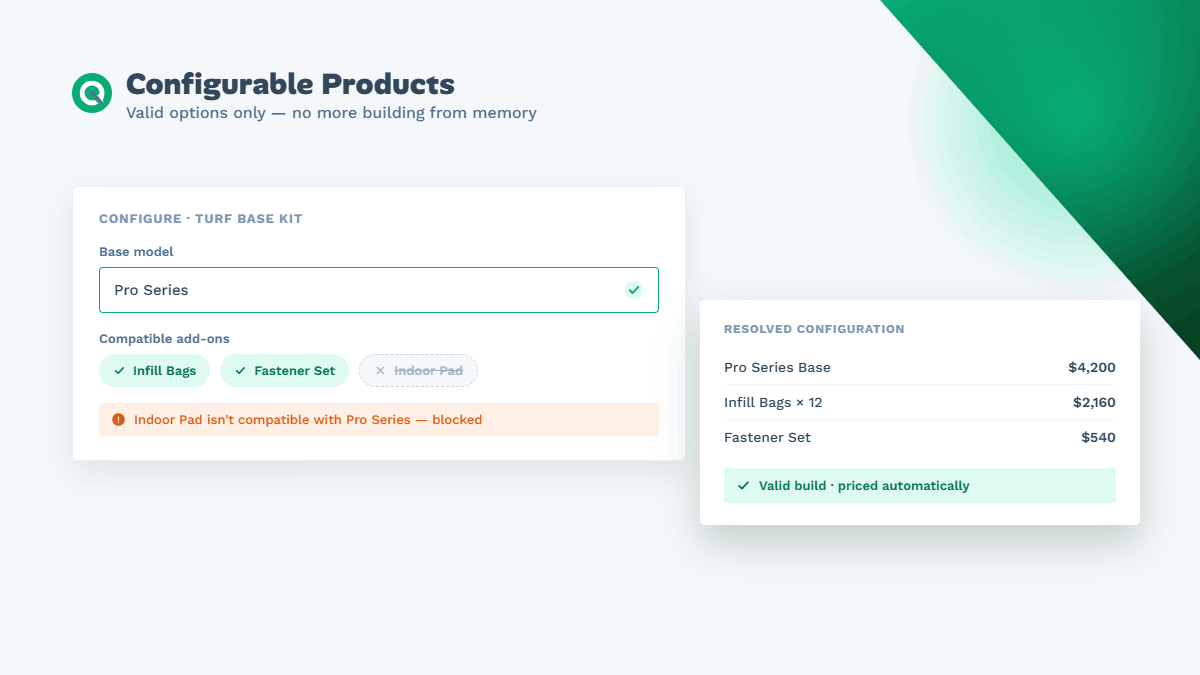
The most common source of quoting errors isn't the wrong price. It's the wrong product.
When reps build quotes from scratch, they rely on memory, outdated spreadsheets, or the one person who knows all the rules. As one PowerTurf manager described their situation: "We've got one guy in the company that controls all the bolts." That's tribal knowledge, not a system. It doesn't scale, doesn't transfer when that person leaves, and doesn't protect you from the rep who's three months in and guessing.
Configurable Products in Quotivity encode your product logic into the quoting tool itself. Bundles, variants, compatibility rules, add-ons, quantity constraints: all of it lives in the product definition. When a rep builds a quote, they're selecting from options Quotivity has already validated. An invalid combination can't be selected. The right configuration and price appear automatically.
At True North, the impact was immediate. "Most of our junior reps just grabbed it, and they love it — they don't have to remember all of the different subtypes," said Kalee Nichols. That's what product configuration solves: it takes configuration knowledge out of people and puts it where it belongs, in the product itself.
What this fixes: Misconfigured quotes, products quoted that can't be built, tribal knowledge dependency, and the manual overhead of checking every quote against product rules.
Guided Selling: Remove the guesswork from the start of every quote
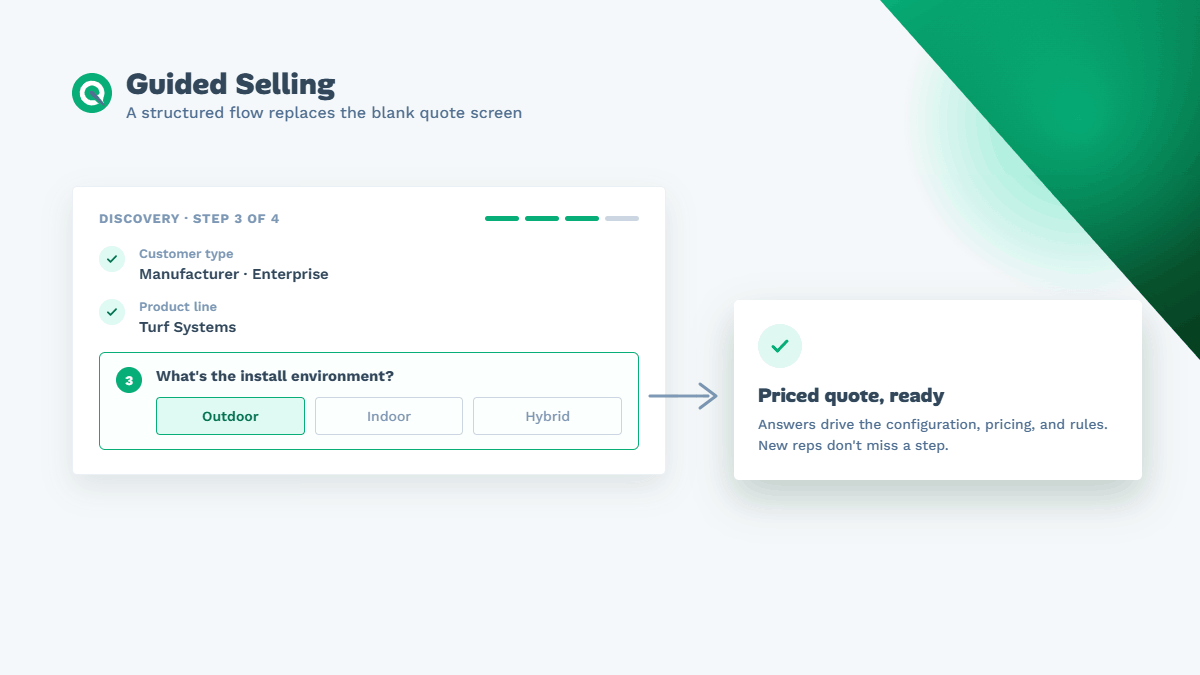
A blank quote screen is a problem. It puts the entire burden of deal discovery on the rep and produces wildly different results depending on who's building the quote.
Guided Selling in Quotivity replaces the blank screen with a structured set of questions. Before the quote is built, the rep answers a discovery flow that captures the context the quote actually needs: deal size, customer type, product line, use case, whatever your process requires. Those answers drive the configuration, trigger the right rules, and hand off directly to the quoting engine.
Where applicable, this feeds Quote Automation, which produces a priced, configured, templated proposal from the completed discovery flow with minimal manual steps. The result is that quoting stops being something that varies by rep and starts being something that follows a consistent process. A junior rep doesn't need to know everything a senior rep knows to build a correct quote. They answer the questions; the system does the reasoning.
This matters most during onboarding. When the quoting process is implicit (in a rep's head), it takes months for new hires to internalize. When it's structured into a guided flow, it's learnable in days. "Our guys just don't miss things now," Kalee Nichols noted.
What this fixes: Inconsistent quoting across reps, steep onboarding for new hires, missing information that forces revisions, and the time gap between discovery and a complete proposal.
Calculated Pricing and Price Books: Replace spreadsheets with math that runs automatically
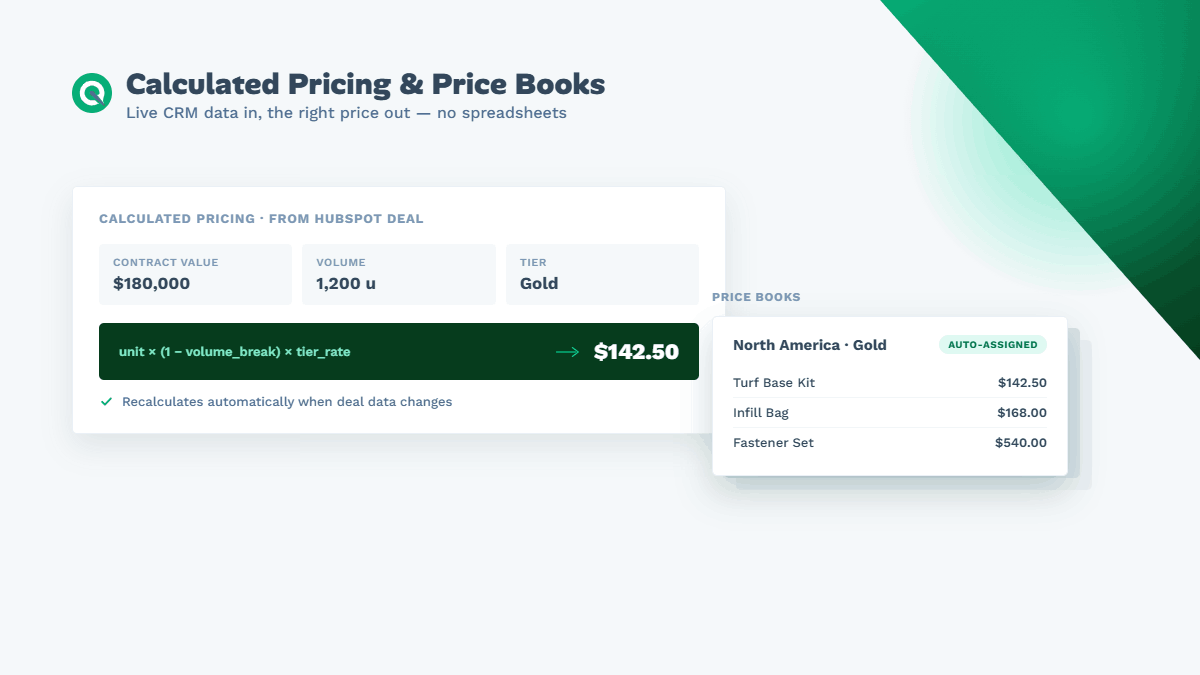
The spreadsheet problem in quoting shows up in predictable forms.
One is the version problem: the rep is working from a pricing spreadsheet that's months out of date, and nobody updated it after the last price change. The quote that goes out reflects numbers that no longer apply.
Another is the complexity problem. "We don't really have a list price — everybody decides what margin they want," as the team at Pellerin described their situation. "Our margins are exposed to the entire sales team." When pricing logic is too complex to put into a simple spreadsheet, or when reps are expected to do the math themselves, the exposure is real.
Calculated Pricing in Quotivity replaces manual math with formula-driven logic that pulls from live CRM data. Headcount, contract value, volume, customer tier, deal context: any of it can feed the pricing formula. The right number appears automatically, without the rep consulting a document or doing arithmetic under pressure.
Price Books handle segmentation. If your pricing varies by region, product line, customer type, or channel, Price Books let you manage multiple catalogs in one place. The right Price Book assigns itself based on deal context. Reps never have to figure out which pricing applies.
The combined result: pricing is always current, always contextually correct, and never dependent on the right person being in the office.
What this fixes: Stale pricing from outdated spreadsheets, manual margin calculation errors, inconsistent pricing across regions or customer segments, and the cost of maintaining separate pricing documents for every scenario.
The Rules Engine: Make your organizational policies automatic, not optional
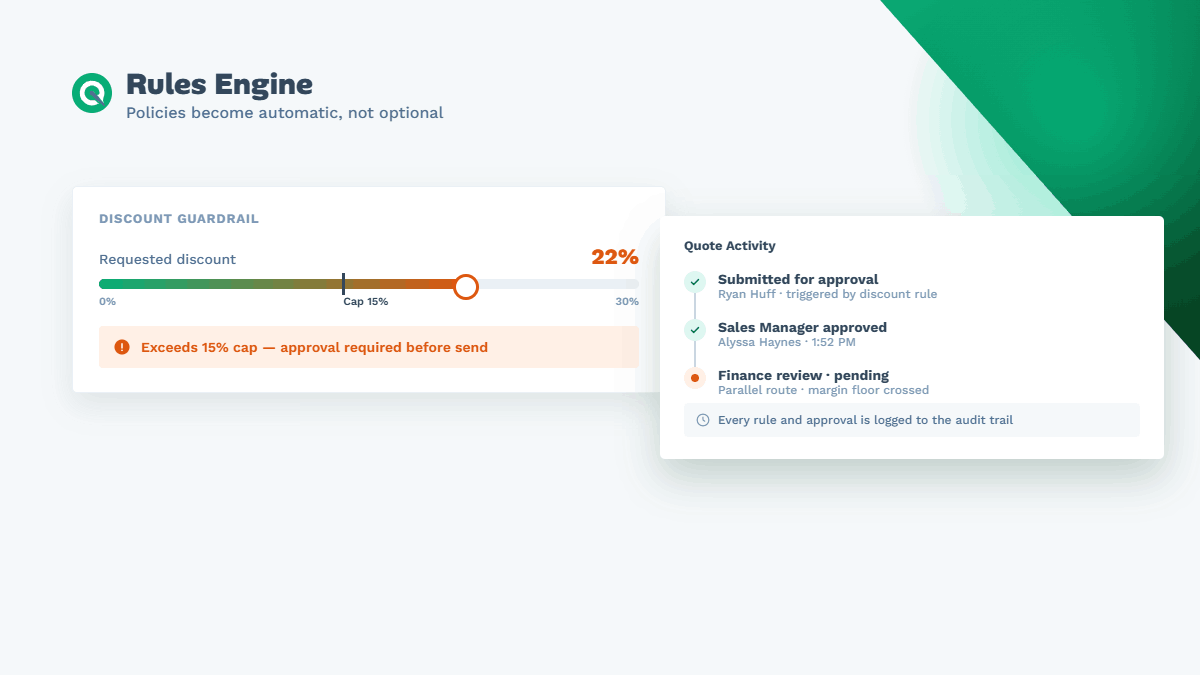
Every quoting process has policies. Discount limits, approval thresholds, required product fields, pricing controls. The problem is that most of the time, those policies live in a document or in the sales manager's head, and whether they get applied depends on the rep remembering them.
This is where revenue leaks. When pricing is uncontrolled, quotes go out with margins that don't hold. When approvals are informal, deals either wait too long or skip the step entirely. When policies live in people rather than in the system, they're applied inconsistently.
Quotivity's Rules Engine puts those policies into the quoting tool itself. Discount caps enforce automatically. Approvals trigger based on conditions you define: margin floor crossed, discount threshold exceeded, specific product type selected. Multi-stage and parallel approval routing handles complex sign-off requirements without manual coordination.
At Aptarro, the effect on rep behavior was direct: "Sales reps are incentivized to stick to price book because they can get their deal out the door much faster," said Renée Durrance. That's what good system design does. It makes the compliant path the fast path. The rep doesn't need to be reminded to follow the policy; following it is the path of least resistance.
The Rules Engine creates an audit trail, too. Every approval decision, every triggered rule, every exception is logged. When a deal closes and someone asks why the margin was what it was, the answer is in the system.
What this fixes: Reps over-discounting, approval delays from informal routing, inconsistent policy enforcement, margin leakage from missed guardrails, and the absence of a paper trail for pricing decisions.
How the four systems work together inside HubSpot
Each of these systems solves a real problem on its own. Together, they close the loop on the quoting process, and all of it happens inside HubSpot Sales Hub and Revenue Hub.
A rep opens a deal record and starts a quote. Guided Selling walks them through discovery, capturing the context the quote needs. That context feeds into Configurable Products, which produces the right configuration automatically. Calculated Pricing assigns the right price based on deal data. The Rules Engine checks the discount, flags policy violations, and routes for approval if required. Quote Automation builds the templated proposal.
What used to take hours, multiple lookups, a call to the pricing expert, and a manual approval chain happens in a single session. Deal records, workflows, reporting, and CRM data stay exactly where they are. Quotivity makes quoting smarter without adding a second system to manage.
Frequently asked questions
What is a quoting process? A quoting process is the set of steps a sales team follows to turn a customer request into a priced, approved proposal. A well-defined quoting process covers product configuration (making sure the quote reflects valid products), pricing logic (applying the right prices, discounts, and margins), approval routing (getting the right sign-offs before the quote goes out), and proposal delivery. Most quoting problems trace back to one of these four areas being informal, inconsistent, or absent.
What causes a broken quoting process? Broken quoting processes typically have four root causes: product logic that lives in people's heads rather than the system (causing misconfigured quotes), pricing rules that live in spreadsheets rather than the CRM (causing stale or incorrect prices), approval steps that are informal or untracked (causing delays or missed governance), and no structured starting point for building a quote (causing inconsistency across reps). Each of these has a system-level fix; none of them are fixed by retraining reps.
What is Configurable Products in CPQ? Configurable Products in CPQ refers to a product setup where items have options, variants, and compatibility rules that the quoting tool enforces automatically. Instead of a rep selecting line items from a flat list, they configure a product by making choices — and the system allows only valid combinations. This prevents misconfigured quotes from leaving the building and eliminates the need for a senior rep or product expert to review every configuration manually.
What is Guided Selling in CPQ? Guided Selling in CPQ is a structured discovery flow that reps complete before or during quote creation. Instead of starting from a blank screen, the rep answers a series of questions about the deal — customer type, product needs, deal context — and those answers drive the product configuration, pricing, and rules that apply to the quote. Guided Selling reduces inconsistency across reps and makes it possible for a new hire to build an accurate quote without having internalized every product and pricing rule.
What is a Price Book in CPQ? A Price Book in CPQ is a catalog of products and their prices, organized for a specific segment — a region, customer tier, product line, or sales channel. A CPQ with Price Books lets companies maintain multiple price catalogs in one place and assigns the right Price Book to each deal automatically based on deal context. This eliminates the need for reps to look up which pricing applies and prevents quotes from going out with the wrong prices for the customer type.
What is a CPQ Rules Engine? A CPQ Rules Engine is a configuration layer that enforces business policies during the quoting process. Rules can cover discount limits (blocking quotes that exceed a threshold), approval routing (triggering a multi-stage approval when margin drops below a floor), product compatibility (preventing invalid combinations from being quoted), and required fields (ensuring a quote can't be submitted without necessary information). A Rules Engine takes policies that previously lived in documents or managers' heads and makes them automatic.
How does Quotivity work with HubSpot? Quotivity is built directly inside HubSpot Sales Hub and Revenue Hub. It does not require a separate system or a data sync. Reps build quotes from the deal record, using the same HubSpot interface they already work in. Deal data, contact data, and company data from HubSpot flow directly into Quotivity's pricing logic and rules. Approval decisions and quote activity are logged against the deal record. There's no second login, no data mapping, and no separate admin surface.
When do I need Quotivity versus HubSpot's native quoting? HubSpot's native quoting works well for simple, straightforward deals. Quotivity is the right addition when your products require configuration logic (bundles, variants, compatibility rules), your pricing requires formulas or segment-specific price books rather than static list prices, or your approval process needs conditional routing rather than a single sign-off. If reps are currently relying on spreadsheets, calling colleagues for pricing, or building quotes differently from each other, that's a signal native quoting has been outgrown.
See how it works
Quotivity is built for revenue teams on HubSpot whose quoting process has outgrown native tools — manufacturers, tech companies, and anyone selling configurable products with complex pricing and approval requirements.
If your team is on HubSpot and still quoting with spreadsheets, waiting on pricing approvals that take days, or watching reps set their own margins, book a demo to see Quotivity against your actual products and pricing.
Go deeper:
- What Is CPQ Software? — the broader category, and where Quotivity fits
- What Is Revenue Leakage? — the financial cost of a quoting process without guardrails
- CPQ for Manufacturers — how quoting chaos shows up specifically for configure-to-order manufacturers
- How True North Recovered 30% Margin — case study
- How Aptarro Cut Negotiation Time by 79% — case study