Configurable products
Can HubSpot handle configurable products?
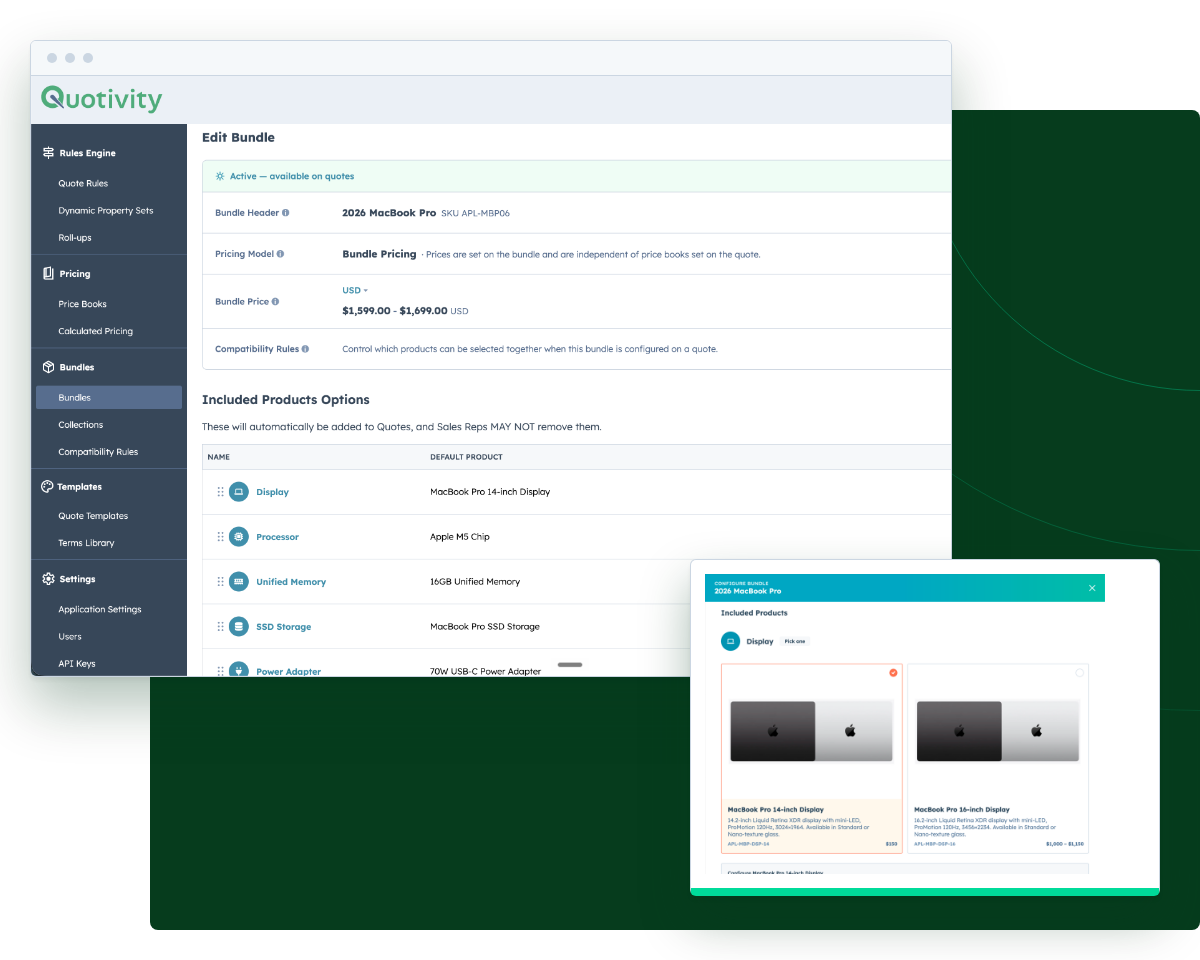
Not natively. HubSpot has no bundle object, and the workflow action that adds a line item cannot edit or remove it afterwards. With Quotivity, yes: bundles with options, option groups, compatibility rules and roll-up pricing. The useful next question is what that means for the bundles you have already built.
Not native · Cited to HubSpot's docs · Free analysis of your own org
What native HubSpot does
There is no bundle object. A product in the product library is a single sellable item: it cannot carry options, option groups, or rules about which choices can be combined. You can sell a product that happens to represent a bundle, but nothing in HubSpot knows what is inside it or which combinations are valid.
Automation does not close the gap either. The workflow action that adds a line item to a deal adds one product, at a fixed quantity and list price. It cannot apply a discount, edit the line afterwards, or remove it. Quote rules can warn a rep or block publishing once a quote has been assembled, but they do not constrain how it gets assembled in the first place.
What it looks like in Quotivity
A configurable product is a real object. It carries options, grouped into option groups the rep chooses from, with compatibility rules governing which combinations are allowed — required pairings, exclusions, and minimum or maximum counts per group.
Pricing rolls up. The bundle shows what is included and what it costs as a whole, without exposing component prices to the buyer unless you want them shown. Bundles can nest, and the nesting survives the move.

| What you have in Salesforce CPQ | Where it lands in Quotivity | What to expect |
|---|---|---|
|
Product options
|
Bundle options
|
Still options. They hang off the bundle differently.
|
|
Product features
|
Option groups
|
Your feature groupings become the groups reps choose from.
|
|
Min and max option counts
|
Allow-multiple options, with a roll-up and a block rule holding the count
|
Native HubSpot cannot enforce a count at all.
|
|
Option constraints and dependencies
|
Compatibility rules
|
What is buried in your constraint records becomes something you can read and edit.
|
|
Configuration attributes
|
Guided selling questions
|
Covered in full on the guided selling page.
|
|
Nested bundles
|
Configurable products, nesting intact
|
Depth is the biggest single factor in how long a rebuild takes.
|
What this means in practice
If your reps need to assemble valid combinations, filter incompatible choices, or build a quote from controlled bundle logic, native HubSpot is not the end state.
- The bundle question is rarely cosmetic. It usually connects to pricing, approvals, assembly, and fulfillment.
- The real sizing variable is depth. A shallow bundle is one job. Deep nesting is another.
- Not every bundle is a bundle. Some turn out to be a product with a few fixed extras, and those land cleanly in the native product library.
You have seen where each construct lands. The analysis counts how many of each you actually have — options, features, constraints, configuration attributes — and reports how deep your bundles nest, which is the number that sizes the work.
Part of the Salesforce CPQ to HubSpot guide. See also where native HubSpot quoting stops.
