
CPQ for HubSpot, built for configurable products.
Every quote easy, fast, correct, and inside policy.
Quotivity puts the pricing rules in HubSpot. Quotes take minutes, and the margin you planned is the margin you keep.
Aptarro's negotiation cycle went from 29 days to 6.
Who we help
Four people touch every quote. Here is what each one gets back.
Easy
Reps want it easy.
Answer a few questions on the deal and the quote builds itself. Valid options only, and the right price book. Nothing to look up, nobody to ask. One customer's reps go from the first question to an accurate quote and proposal in under two minutes.
Fast
Sales wants it fast.
A quote that waits two days for an approval is a deal going cold. Caps and routing run while the rep builds, so a quote inside the rules never enters a queue. Watershape's complex proposals ran 90 minutes or longer. Now they run 10-15.
Correct
Operations wants it correct.
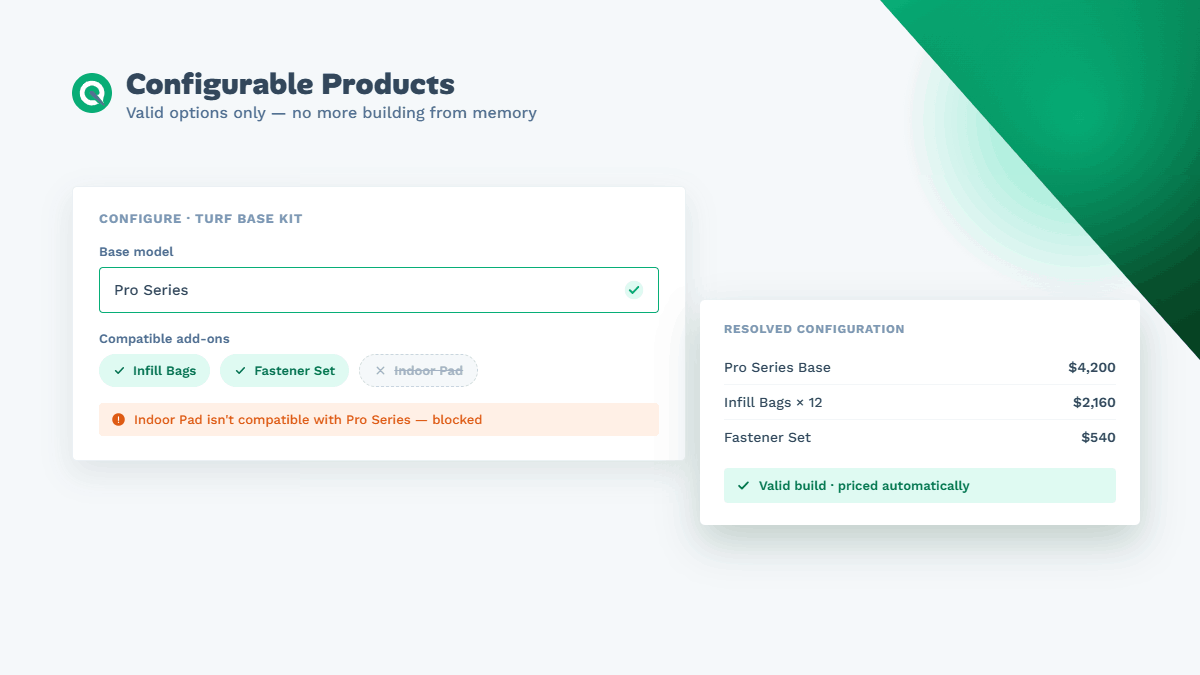
The rules live in HubSpot, not in a spreadsheet on one desktop. Reps can't pick a combination that can't be built, and required fields can't be skipped. Every value writes back to the line item. You stop being the person every quote waits on.
Inside policy
Finance wants it inside policy.
Set the floor once. Anything past it waits for an approval, and approvals hold after you give them. Margin questions get answered in HubSpot reporting.
What is Quotivity?
Quotivity is a HubSpot-native CPQ (configure, price, quote) app. It's quoting software for what a standard product list can't describe: options that constrain each other, and prices that change depending on who's buying. A rep configures on the HubSpot record without seeing a combination your rules say can't be built, and the finished quote writes to HubSpot's own records.
Your quoting runs on a spreadsheet and one person's memory
Where the pricing logic actually lives
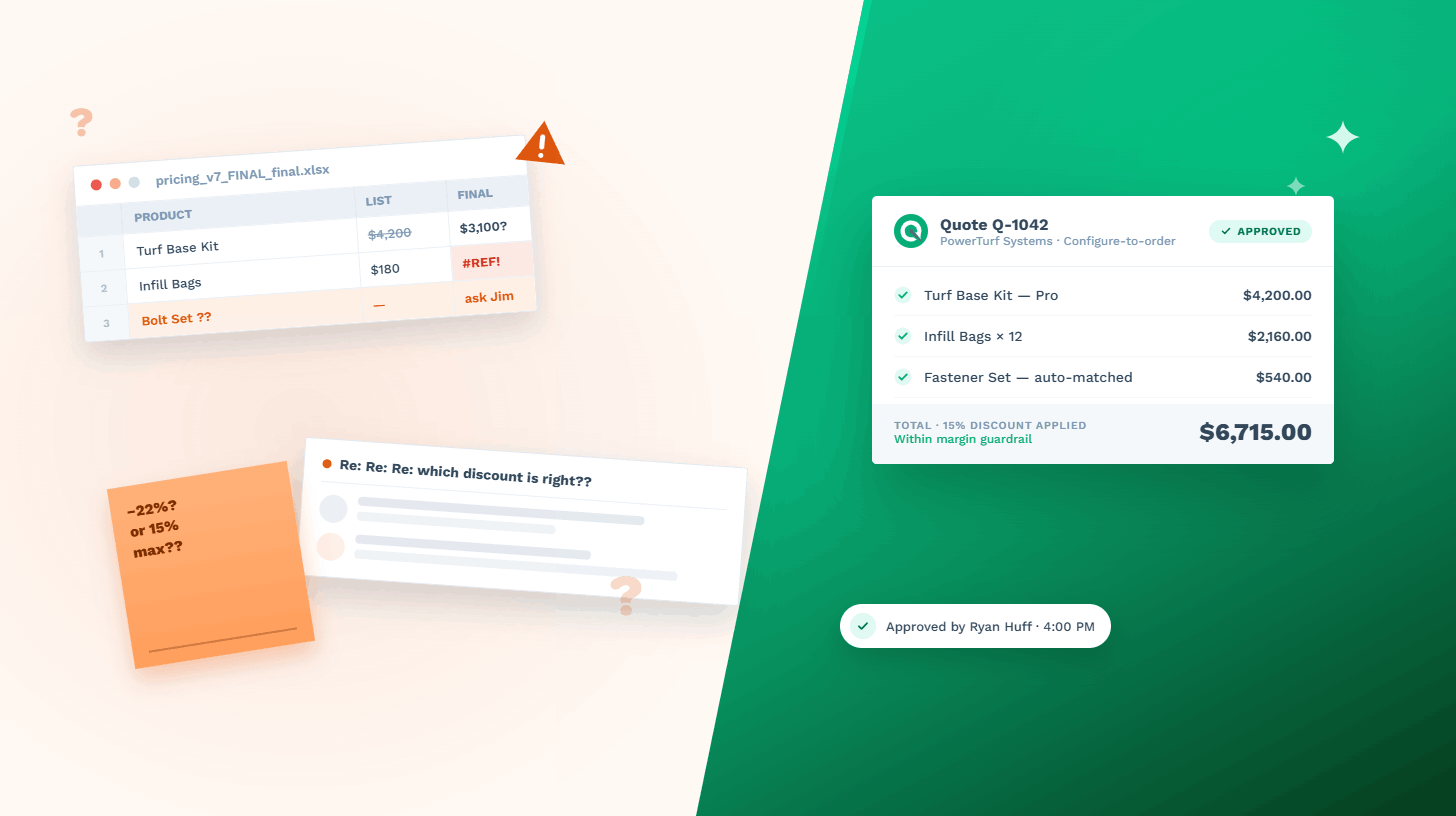
Ask a company how it prices and you get a system. Watch it price and you get a spreadsheet. An Excel calculator, a pricing matrix in Visual Basic, a 42,000-row lookup, a price book saved to a rep's desktop two years ago. It works, because someone built it to work.
Then that person takes a week off, or a job somewhere else.
Of the companies we talked to this summer, about a dozen kept their pricing logic in a spreadsheet. In at least six of them, the person who built it had already left, retired, or was two weeks from leaving. Nobody else could read it.
We've got one guy in the company that controls all the bolts.
 A PowerTurf manager
That isn't a people problem. It's the absence of a system, and the spreadsheet is what grew in its place.
And nobody trusts the quote
Where the money goes when the rules aren't in the system
Every quote that leaves the building is an act of faith. The rep doesn't know it's right. Sales doesn't know it'll be right the first time. Ops doesn't trust a rep to build it alone. Finance doesn't know what discount is on it. Here is where the money goes.
Deals cool in a queue. Approval means tagging someone in a note. One commercial lead described his own turnaround: "I can sometimes be two or three days. So I'd say let's call it four days."
Wrong quotes get re-quoted lower. Engineering catches the invalid configuration a week later. The customer gets a second number, and now you're negotiating against your own first offer.
Margin leaks one discount at a time. Reps trim the markup for customers they like, and nobody sees it until the quarter closes.
Line items get forgotten. One firm sold the media space and forgot the production cost. Nothing in the spreadsheet stopped it.
The report is wrong, and it's yours.
…it will be worse for me if I go to the business and say, 'Hey, it's gonna cost us this,' and then I get back and say, 'Well, actually, it is…'
We know why the spreadsheet exists
Why this won't be the third thing you tried
You built it because HubSpot didn't do the calculation at the time, and the business needed a number. It worked. Most of the companies we meet have already been through one CPQ that didn't work, a partner that turned over their staff three times, a year of implementation with nothing to show a leadership team, or $250,000 on a CPQ nobody used.
They want to know why this will be different. Here you go:
We won't reproduce your spreadsheet. No CPQ does, and we'd rather say so now. We'll read it with the person who built it and encode the part that matters. Our pricing is published. We'll tell you if we can't help you. Onboarding is a stated one-time fee. Support chat is a person.
5.0 across 18 reviews on the HubSpot marketplace. 400+ installs.

Sales

Operations

Finance
What you get
Four systems, and the failure each one prevents
Inside HubSpot, replacing what you do by hand
Each one replaces something you're doing by hand today, and each one stops a specific mistake before it reaches a customer.
Configurable Products
What it replaces
The rep building a quote from memory, a list of forbidden part-number pairs, or the one person who knows.
The failure it prevents
The wrong product. A rule reads attributes, so a rule for 480-volt gear covers every SKU that carries it, including the ones you add next spring. An invalid combination can't be selected.
Who stops waiting
The rep. There's nobody to go and check with.
Guided Selling
What it replaces
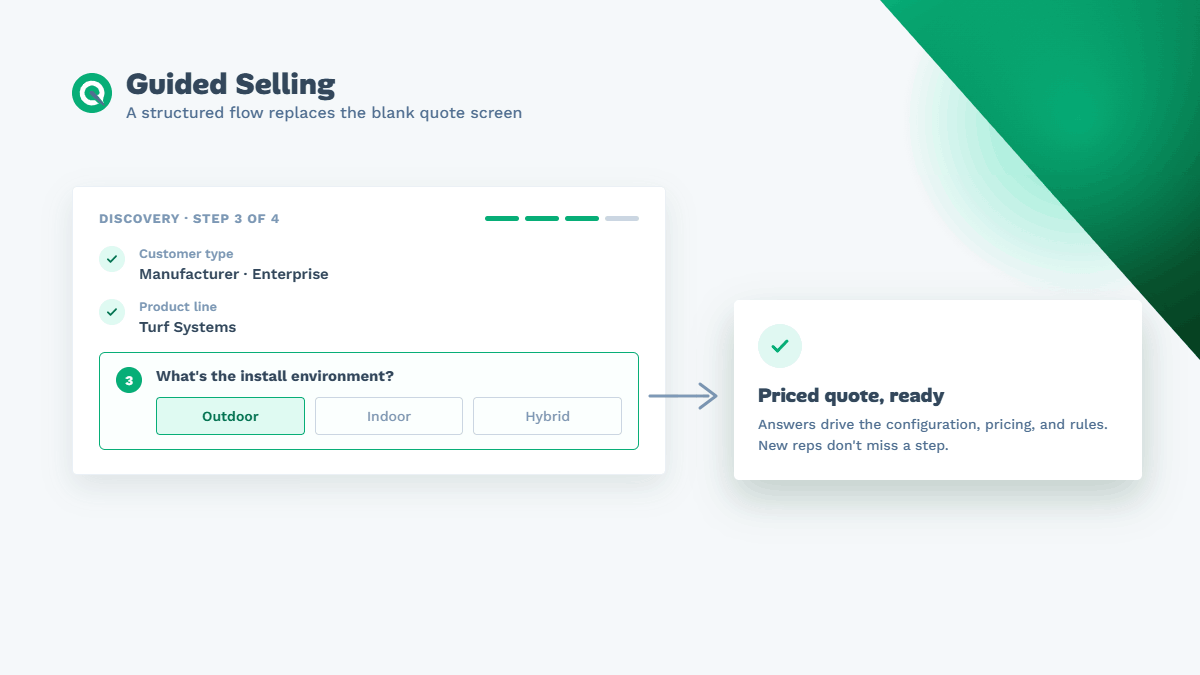
The blank quote screen, and the months a new rep spends learning which questions to ask.
The failure it prevents
The skipped question. Discovery comes in a fixed order. A rep hired Monday runs the same path as the one who's been there nine years.
Who stops waiting
The new rep, who quotes alone, and the manager who used to chaperone them.
Calculated Pricing and Price Books
What it replaces
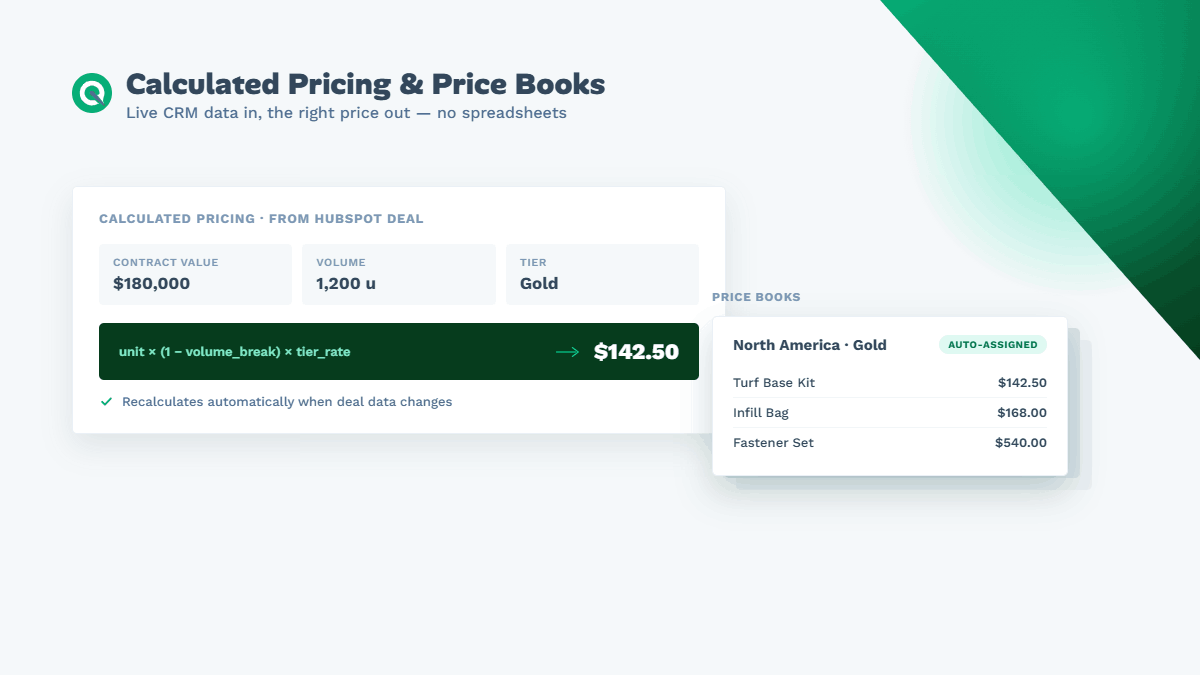
The pricing spreadsheet that's months out of date, and four copies of every product, one per segment.
The failure it prevents
The stale price. Price Books are on both plans, so one bundle serves every segment, because the options inside it price from whichever book the quote is assigned. Calculated Pricing is on the Enterprise plan, and standalone products go further there: a different formula per price book, per product.
Who stops waiting
Finance, for a number they can trust.
Rules Engine and Approvals
What it replaces
The policy that lives in a document or the sales manager's head.
The failure it prevents
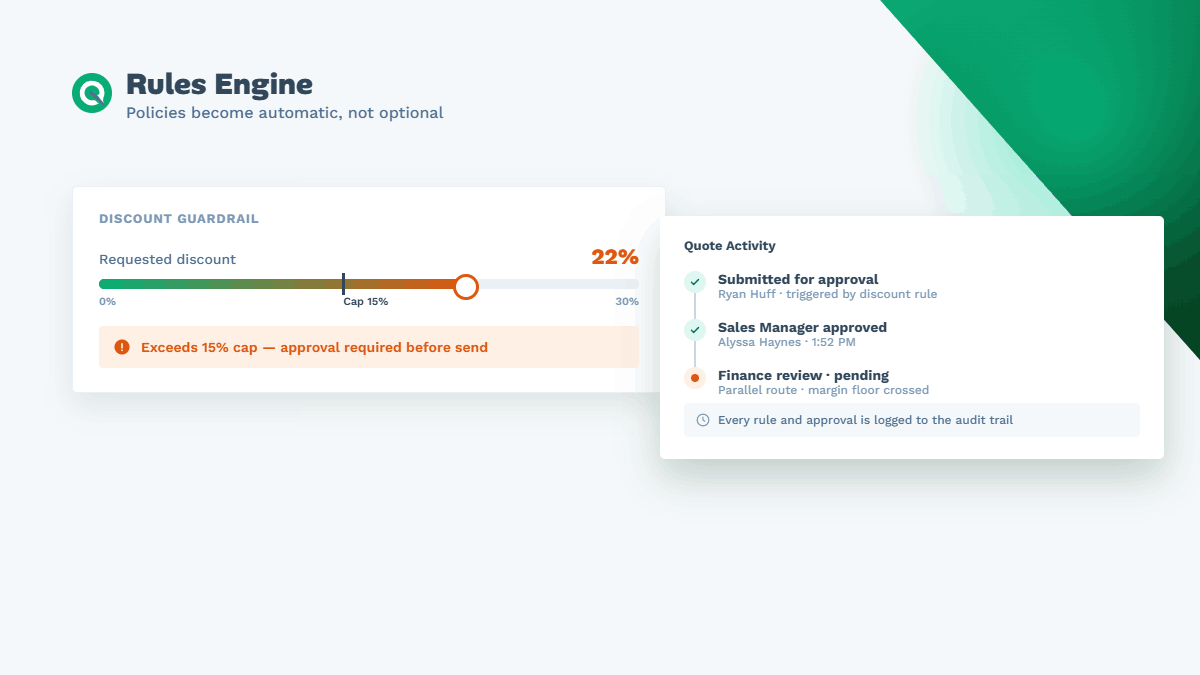
The discount nobody had to ask for. Caps enforce while the quote is built. Anything past the floor routes for approval before it sends, not after. An approved quote stays approved. A rep can't recall it and quietly change it.
Who stops waiting
Everyone. The compliant path is the fast path.
How it works, in three steps
From spreadsheet to HubSpot in weeks
1
Put your rules in HubSpot.
Bring the spreadsheet and the person who can read it. We encode the product logic, the price books, and the discount policy together. Weeks from kickoff to a quote you can send.
2
Reps quote complex products without waiting on anyone.
A rep answers the questions and the quote builds itself. Invalid combinations never appear. The right price book assigns itself. A discount past the cap routes for approval first.
3
Make more money.
Quotes go out fast, correct, and inside policy. Every one of them is on the HubSpot record. Deals stop cooling. Margin stops leaking. The number leadership sees comes from the system.
Side by side vs. HubSpot's native quoting
Native quoting covers more than it did two years ago. If it covers what you sell, use it. Here's the line.
| HubSpot native | Quotivity | |
|---|---|---|
|
Bundles
|
Yes
|
Plus required and mutually exclusive components
|
|
Approvals
|
Yes
|
Plus conditional routing
|
|
Attribute-based compatibility rules
|
No
|
Yes
|
|
Guided selling flows
|
No
|
Yes
|
|
A different pricing formula per price book, per product
|
No
|
Yes, on Enterprise
|
|
Where the quote data lives
|
HubSpot
|
HubSpot
|
HubSpot native capabilities as published. "No" means not part of native quoting today.
Pricing, seat math, and the full row-by-row are on Quotivity vs HubSpot's native quoting.
Proof
The numbers, from customers who'll say so
Three customers, three numbers
Days in negotiation, from 29
Fewer errors got out the door, so there was less to claw back afterward. Deal-review calls got shorter, and some stopped happening.
Realized margin re-captured
Junior reps picked up configurable products right away and stopped having to remember the subtypes. The full benefit took about eighteen months.
Person to send a proposal
Down from 6, at a design and engineering firm with roughly 2,000 SKUs of professional services.
Sales reps are incentivized to stick to price book because they can get their deal out the door much faster.
 Renée Durrance
Senior Director of Business Systems, Aptarro
Renée Durrance
Senior Director of Business Systems, Aptarro
Most of our junior reps just grabbed it, and they love it — they don't have to remember all of the different subtypes.
 Kalee Nichols
manager, True North
Kalee Nichols
manager, True North
Simple proposals that required 30 minutes are down to 3 minutes. Complex proposals that required 90 minutes or longer are down to 10-15 minutes.
 D. Peterson
Watershape
D. Peterson
Watershape
When we tell people no
Two conditions, and both are checkable before you book anything.
If your configurations nest — a configured assembly that becomes a component inside another configured assembly — Guided Selling won't run it.
Second, compatibility Rules encode product knowledge. They don't discover it. If nobody at your company can sit down and write out which options can't go together, onboarding turns into the two of us staring at each other. Bring the person who knows, or don't buy this yet.
Questions we get before a demo
One ugly quote, thirty minutes
Pick the configuration your reps get wrong most often. We'll build it on the call, inside HubSpot, and you'll see where it holds and where it doesn't.