COMPARISON
DealHub vs Quotivity, the HubSpot-Native DealHub Alternative
DealHub built a great HubSpot integration. Quotivity is built inside HubSpot. The same data model, the same UI your reps already use, and no second admin surface to maintain.
If HubSpot is your source of truth and you want it to stay that way, this page is for you.
If you need a standalone CPQ that lives outside HubSpot, DealHub is probably the right call, and we say so further down.
What teams told us after evaluating DealHub
"Where DealHub failed is in really understanding all of the business processes."
"They have an admin just for DealHub and that's not something we're looking for."
"I would be running without a system before I renew DealHub at this point."
"Overbuilt for a simple use case."
HIGHLIGHTS
Native HubSpot CPQ at a fraction of the implementation effort
DealHub CPQ is a strong option for teams that want a separate quote-to-revenue platform. Quotivity is built for HubSpot teams that want advanced pricing, approvals, product configuration, and quote governance without moving reps into another system.
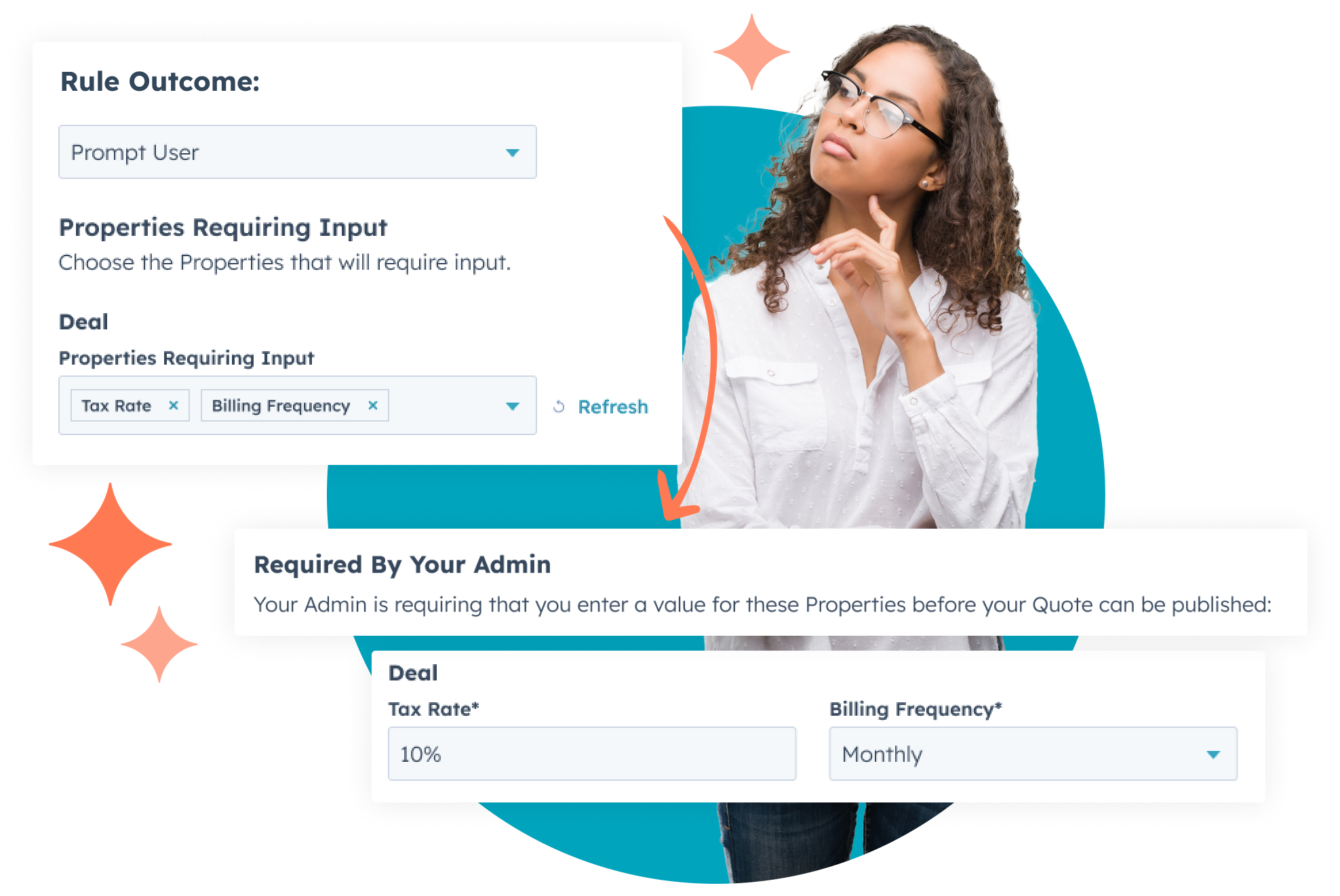
With Quotivity, you get advanced CPQ functionality including price books, approval workflows, calculated pricing, and compliance controls directly in HubSpot.
Pick Quotivity if HubSpot is your CRM, you have a RevOps lead instead of a dedicated CPQ admin, and your team is 20 to 300 people quoting configurable products or SaaS subscriptions. You get CPQ inside the CRM your reps already live in, published pricing, and a 6-week implementation.
Pick DealHub if you are enterprise SaaS with $100M+ ARR, Salesforce is in the picture, contract management is your primary problem, or you have the budget to staff a dedicated CPQ admin.
Both products work. They're just built for different companies.
Quotivity at a glance:
-
Implemented in about 6 weeks, not 6 months
-
Published price from $5,000/year for 5 users
-
Owned by your RevOps lead, no dedicated admin or outside agency required
DealHub vs. Quotivity, side by side
Most CPQ vendors look similar in a feature grid. The real difference is where the work happens. DealHub CPQ runs through a separate platform connected to HubSpot, while Quotivity keeps quoting, pricing, approvals, and deal visibility inside HubSpot.
|

|
|
|
| Where it lives |
Inside HubSpot. Reps quote on the deal record. |
A separate platform connected to HubSpot by integration |
| Data model |
Native HubSpot deals, line items, products, properties |
DealHub's own database, synced bi-directionally with HubSpot |
| Who owns admin |
Your RevOps lead |
Often a dedicated DealHub admin or outside agency |
| Implementation time |
~6 weeks |
3-6 months. Prospects routinely report missed estimates |
| Onboarding |
$2,500 white-glove quick start |
Custom implementation fee |
| Price |
$5,000/year (includes 5 users) + additional users: $600/year |
Opaque. Quote-only, enterprise tier. Partner/agency fees common. |
|
HubSpot Integration |
||
| Where reps build quotes |
Works directly within HubSpot on all tiers |
Requires switching to separate platform |
| Data Sync |
Real-time (uses HubSpot data directly) |
No sync. Uses HubSpot data live. Line-item drift between systems is a known failure mode. |
| Setup |
~6 weeks |
3-6 months; prospects report missed estimates |
|
CPQ Features |
||
| Approvals |
Configured in HubSpot workflows, conditional on any HubSpot property |
Multi-stage approvals in DealHub's separate admin console |
| Price books |
Dynamic rules tied to live HubSpot data. Segment by region, product line, customer type. |
Comprehensive catalog, maintained separately from HubSpot products. |
| Product bundles and configuration |
Rules engine reads HubSpot data. Configurable on all plans |
Advanced configuration with guided playbooks |
| Calculated pricing (price waterfall) |
Formula-based, reads any HubSpot field |
Powerful calc engine inside DealHub's guided selling |
| Discount governance |
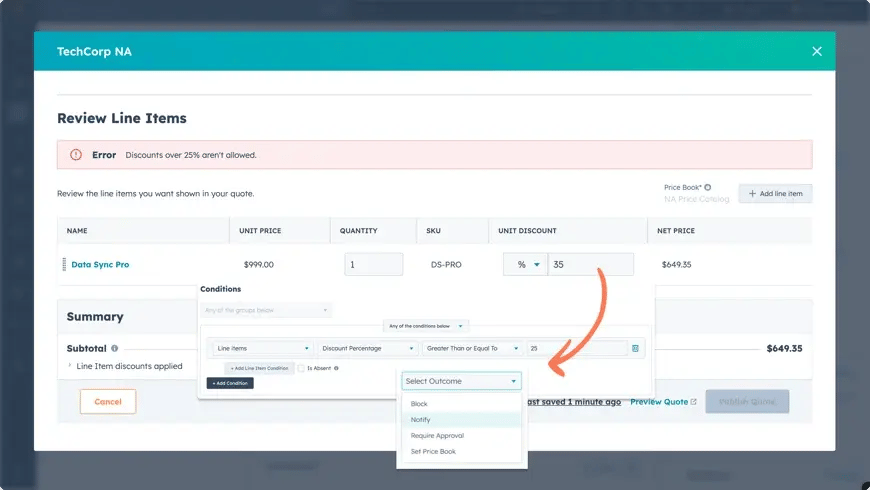
Rule-based thresholds tied to HubSpot data. Blocks non-compliant quotes before send |
Comprehensive discount controls inside DealHub |
| Multi-currency |
Uses native HubSpot currencies |
Supports multiple currencies with conversion |
|
Business Controls |
||
| Compliance rules |
Dynamic rules and alerts |
Complex compliance management |
| Margin visibility |
Dynamic rules and alerts |
Advanced margin protection features |
| User permissions |
HubSpot-based permissions |
Separate role-based access control |
| Audit trail |
HubSpot timeline |
DealHub audit logs |
|
User Experience |
||
| Quote creation |
Directly inside HubSpot on one screen |
Multi-step guided process in separate interface |
| Mobile access |
Uses HubSpot mobile experience |
Separate web interface |
| Customer-facing quote |
HubSpot quote templates plus Quotivity Template Designer (no code) |
Interactive DealRoom microsite |
Why HubSpot teams pick Quotivity over DealHub
If you want a standalone CPQ platform with its own system, UI, and implementation process, DealHub can work. If you want advanced CPQ inside HubSpot without adding another tool, Quotivity is built for that.
1. CPQ inside HubSpot, not bolted onto it
DealHub's HubSpot integration is real and well-built. An integration is still two systems though, which means two admin consoles, two sets of permissions, and two places ARR can disagree. Quotivity uses HubSpot's own data model. Deals, line items, products, workflows. When something changes in HubSpot, Quotivity already knows. When something changes in Quotivity, there is no sync layer to debug at renewal time.
One customer put it cleanly while evaluating DealHub: "It's not integrated into HubSpot at all. It's a third party, and it's completely disconnecting your quote process from HubSpot."
2. Owned by your RevOps lead, not an agency
The most common DealHub complaint we hear is not about features. It's about who maintains the thing. Workflows, approval routes, product rules, pricing tweaks. Every change is either an internal admin's full-time job or an outside agency engagement, and the CFO sees that line item every month.
Quotivity is configured the way HubSpot is configured. If your RevOps lead can build a HubSpot workflow, they can run Quotivity. Implementation runs about 6 weeks (GovPilot is our reference customer here). Ongoing change velocity is measured in hours, not weeks.
3. Published pricing, predictable economics
DealHub doesn't publish a price. We do. That tells you who each product is built for.
| Seats | Quotivity | DealHub |
| 5 | $5,000/yr | Opaque (quote-only) |
| 10 | $8,000/yr | Opaque |
| 20 | $14,000/yr | Opaque |
| 50 | $32,000/yr | Opaque |
Our pricing flattens after the bundled 5 seats, so per-seat cost drops as your team grows. That's a structure built for a team, not a procurement gauntlet.
DealHub CPQ or Quotivity: Which CPQ Vendor Fits Your HubSpot Team?
Both Quotivity and DealHub offer advanced CPQ capabilities for HubSpot users. Both provide powerful features for implementing pricing rules, approvals, and product bundles. Both help streamline your quoting process and improve sales efficiency.
But while DealHub is a separate CPQ platform connected to HubSpot, Quotivity enhances HubSpot's native quoting capabilities directly within your workflow.
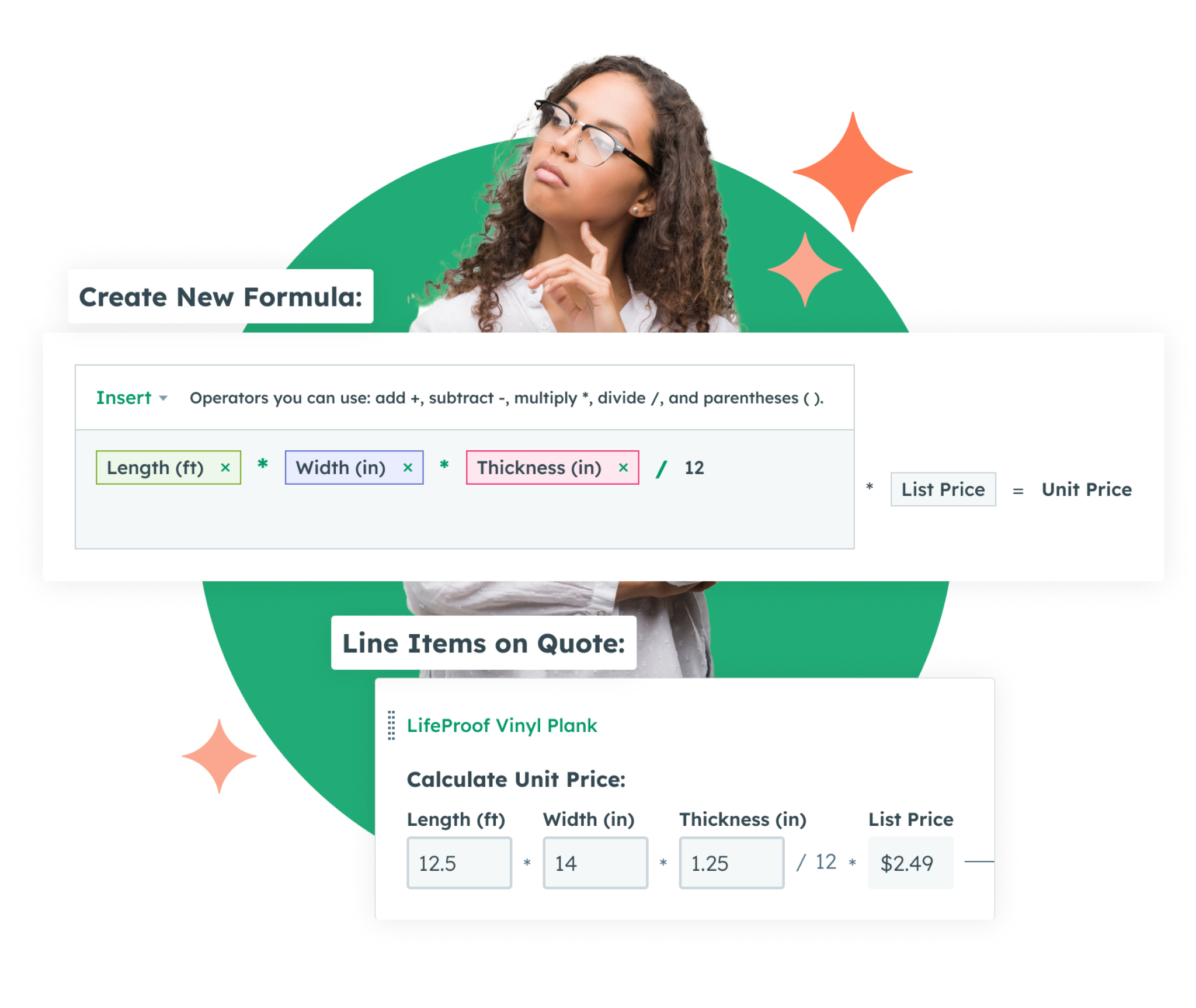
This means you get advanced CPQ features like dynamic bundles, calculated prices, and compliance controls without leaving HubSpot or managing another system. The native approach delivers cleaner data, more accurate reporting, and no platform switching for your team.
Choose DealHub CPQ if your team wants a broader quote-to-revenue platform that can include CPQ, contracts, DealRoom, and billing. Choose Quotivity if your team wants to fix quoting inside HubSpot first, especially when pricing rules, discount controls, bundles, approvals, and quote accuracy are slowing deals down.
Let’s take a closer look at how Quotivity and DealHub stack up.
1. Stay in HubSpot, where your data lives
DealHub offers a robust CPQ platform that connects with HubSpot, but requires your team to learn and use a separate system with its own interface, permissions, and data structure. While the integration does enable a great quoting experience for reps, it's still another platform to manage and maintain.
✅
Quotivity provides advanced CPQ functionality right inside HubSpot where your team already works. Sales reps never have to switch contexts or learn a new system — quotes are created directly from deal records using a familiar, HubSpot-styled interface. This native approach means:
- No additional login credentials or permissions to manage
- No synchronization issues or duplicate data
- No training on a new interface for your team
- Complete visibility of quote data in HubSpot reporting
- Seamless integration with HubSpot workflows and automation
By keeping everything in HubSpot, you maintain a single source of truth for all your sales data while reducing complexity in your tech stack.
2. Build sophisticated approval workflows
Both Quotivity and DealHub offer approval workflows to control discounting and ensure quotes meet your business requirements. The key difference is in how they're implemented:
DealHub offers its own approval engine with similar capabilities, but approvals take place in DealHub's system. While approvals sync back to HubSpot after completion, the process occurs outside your CRM, requiring approvers to use another platform.
With Quotivity, approval workflows operate directly within HubSpot. You can create sophisticated rules using any HubSpot data to determine when approvals are needed.
For example:
- Route quotes with >15% discount to sales managers
- Send deals over $50,000 to the finance team
- Require VP approval for specific product combinations
- Apply different rules based on region, account type, or any custom field
Approvers receive notifications via HubSpot tasks, email, or Slack and can approve with a single click. Every approval action is logged directly in the HubSpot timeline, creating a complete audit trail.
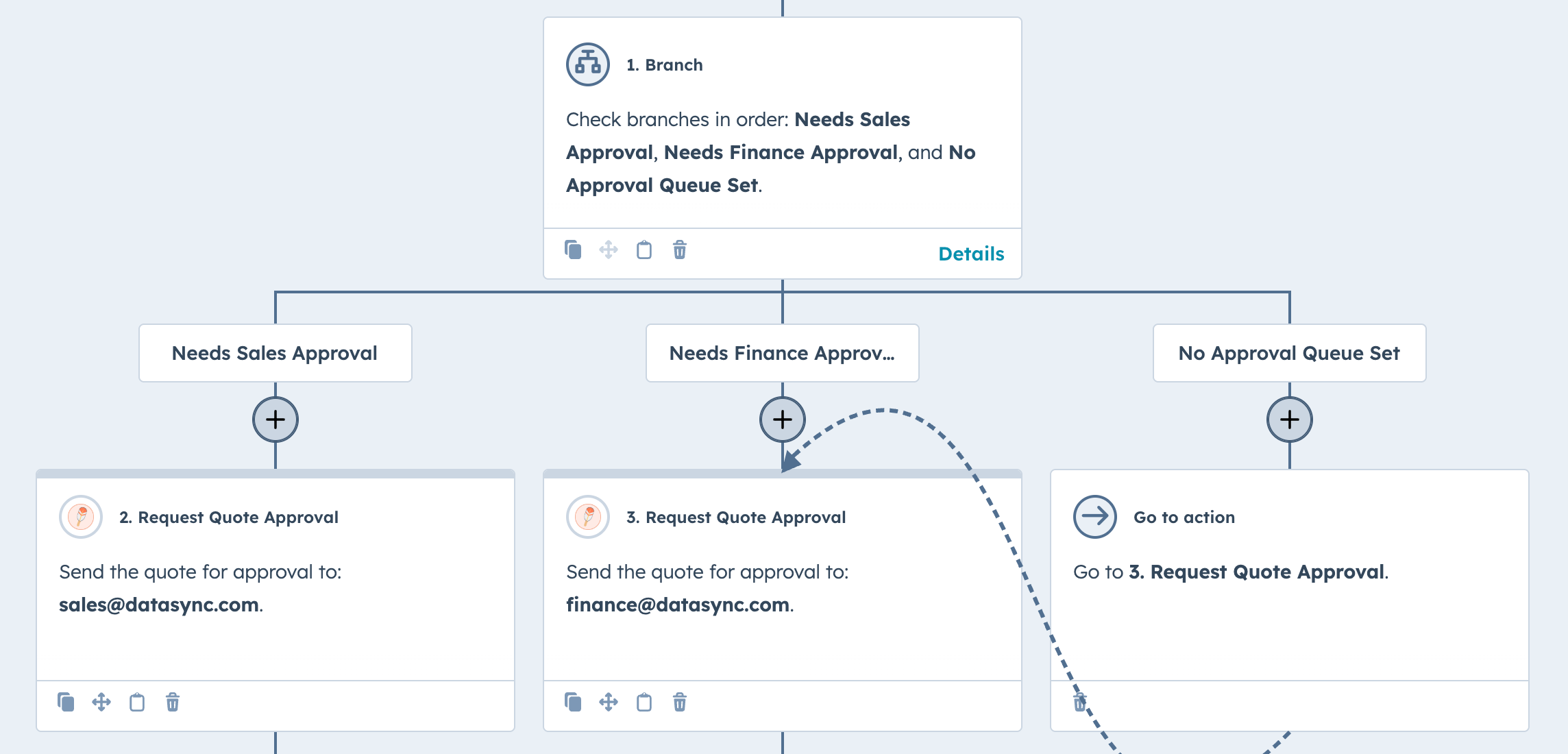
By keeping approvals within HubSpot, Quotivity simplifies your process, ensures compliance, and makes it easy for managers to keep deals moving.
3. Create advanced price books with dynamic rules
DealHub offers powerful pricing capabilities, but requires maintaining a separate product catalog within their system. While this catalog can sync with HubSpot, you're essentially managing two separate repositories of product data.
Quotivity offers true price book functionality built directly into HubSpot, allowing you to create dynamic pricing rules based on any HubSpot data. This means you can sell the same product from your HubSpot catalog at different prices based on factors like:
- Customer segment (enterprise vs. mid-market vs. SMB)
- Geographic region (North America, EMEA, APAC)
- Deal type (new business vs. renewal vs. upsell)
- Volume or quantity thresholds
.png?width=976&height=549&name=EU%20Pricing%20(2).png)
With Quotivity's price books, you maintain a single product catalog in HubSpot while applying sophisticated pricing strategies. This keeps your reporting clean and accurate since you're not creating duplicate products to handle different pricing scenarios.
And by leveraging HubSpot's native product catalog, Quotivity ensures pricing consistency across your entire sales process while simplifying product management.
4. Create professional quotes without leaving HubSpot
Both Quotivity and DealHub help you deliver polished, professional quotes to your customers, but they take different approaches.
DealHub offers a DealRoom experience — a personalized microsite where customers can view proposals, select options, and sign documents. This interactive experience can be impressive for complex sales cycles but requires managing a separate system for document generation and tracking.
Quotivity enhances HubSpot's native quoting capabilities, allowing you to create branded quotes directly from the deal record. Your quotes include all the necessary information:
- Company branding and logos
- Detailed line items with appropriate pricing
- Terms and conditions
- Electronic signature
- Payment options (via HubSpot Payments)
The verdict?
If you value keeping your quoting process within HubSpot while delivering professional quotes your customers can easily review and sign, Quotivity offers the streamlined approach you need.
Frequently Asked Questions about DealHub CPQ vs. Quotivity
Is Quotivity a real DealHub alternative?
For HubSpot teams, yes. Quotivity covers the CPQ core DealHub is best known for: price books, calculated pricing, approval workflows, product configuration, and discount governance, all built on HubSpot's data model. What we don't replace is DealHub's billing module and standalone contract management.
How much does DealHub cost compared to Quotivity?
DealHub doesn't publish pricing. Based on prospect conversations, DealHub deals run quote-only at enterprise tier, often with additional implementation, partner, or agency fees. Quotivity is published at $5,000/year for 5 users, $600/year per additional user, with a $2,500 quick-start implementation.
Is DealHub HubSpot-native?
No. DealHub is a standalone platform with a HubSpot integration. Data syncs between the two systems bi-directionally. Quotivity runs inside HubSpot using HubSpot's native objects, so there is no second database to keep in sync.
How long does a DealHub implementation take?
Prospects we have spoken with report 3 to 6 months, frequently longer than the original estimate, and often requiring partner or agency support to maintain afterward. Quotivity implementations run about 6 weeks with internal ownership.
Can I migrate from DealHub to Quotivity?
Yes. Several of our customers came to us off DealHub or while actively evaluating it. We will rebuild your existing price book and one painful quote scenario in your HubSpot sandbox within 48 hours, no commitment required.
Does Quotivity replace DealHub billing?
No. Quotivity focuses on the CPQ layer: quoting, pricing, approvals, configuration, and governance. If your primary need is billing or revenue recognition, evaluate DealHub or a dedicated billing tool.
Why does it matter where the CPQ lives?
Because reps quote where they sell. If pricing rules, approvals, and quote data live outside the CRM, reps switch tools to do their job, ARR can disagree between systems, and every change means admin work in two places. Native quoting removes that tax.
What about DealHub's deal desk and quote-to-revenue features?
DealHub's deal desk is mature and a real strength. Quotivity covers the quoting and pricing-governance side of deal desk work natively in HubSpot. For teams whose deal desk function is mostly approvals, discount governance, and pricing rules, Quotivity is enough. For teams whose deal desk includes billing and contract redlining, evaluate both.
Quotivity brings Advanced CPQ to HubSpot without ever leaving the platform
If you’re looking for a HubSpot CPQ solution that:
Operates directly within HubSpot, where your team already works
Can be implemented in days rather than months
Provides sophisticated price books, approval workflows, and compliance controls
Delivers enterprise CPQ functionality at a predictable, affordable price
Eliminates the complexity of managing another platform
Then Quotivity is for you.
We can’t wait to see the quoting efficiency it unlocks for you. Want to see more? Schedule a chat with our team!